UL1004-1 Rotating Electrical Machines –General Requirements
First Edition – September, 2008
Second Edition -
September 19, 2012
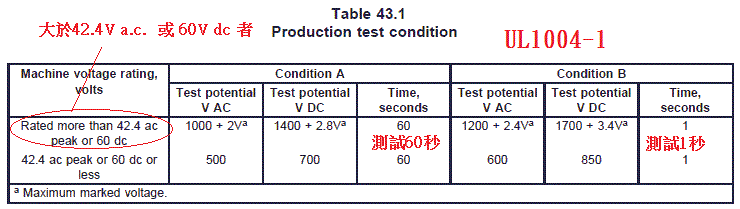
37.1 Each machine shall withstand without electrical breakdown the application of an alternating-current
potential at a frequency within the range of 40 – 70 hertz or a direct-current potential, at a magnitude and
for a duration as described in Table 43.1:
a) Between the primary wiring, including connected components, and accessible dead metal
parts that are capable of becoming energized; and主線圈與金屬外殼之間
b) Between primary wiring and accessible low-voltage – 42.4 volts peak ac, 60 volts dc or less
– metal parts, including terminals and connector contacts.
主線圈與低壓42.4 volts peak ac, 60 volts dc or less隔離金屬
37.2 The test potential specified in Table 43.1 is to be obtained from any convenient source having a
capacity of at least 500 volt-amperes. The capacity may be lower when a meter is located in the output
circuit, and the test potential is maintained except in case of breakdown. The voltage of the source is to
be continuously adjustable. Starting at zero, the applied potential is to be gradually increased until the
required test value is reached.
37.3 Printed-wiring assemblies and other electronic-circuit components that are damaged by application
of the test potential or that short-circuit the test potential are to be removed, disconnected, or otherwise
rendered inoperative before the dielectric voltage-withstand tests are made. Testing a representative
subassembly instead of an entire unit is not prohibited. Individually shunting the semiconductor devices in
the unit before the test is made to avoid destroying them in the case of a malfunction elsewhere in the
secondary circuits is not prohibited.
37.4 While at operating temperature, the ac and dc power circuits shall withstand without breakdown the
application of a potential as specified in Table 43.1.
37A Commutator Conditioning Test
37A.1 The sample motor shall be operated with its rated or intended load, such as a fan load for a
vacuum cleaner suction motor, for a period of 100 hours or end-of-life, whichever occurs first. At the end
of the conditioning, the motor shall be brought to room temperature and shall comply with 37.1.