
UL1004-1 Rotating Electrical Machines –General Requirements
June 22, 2016
42.1 General
42.1.1 The machine enclosure or frame is to be connected to ground through a 3-ampere non-time delay
cartridge fuse having a voltage rating consistent with the machine rating.馬達外殼接地串3A保險司
42.1.2 For motors, the rotor is to be locked in a stationary position using a means of low thermal
conductivity (such as wood) and energized.馬達堵住
42.1.3 For generators, the generator output is to be loaded so as to accomplish the same objectives. If
the generator output is connected to an overcurrent protective device or voltage-regulating unit, the device
or unit is to be bypassed if necessary.
42.2 Motors not provided with thermal motor protection馬達保護器要by-pass
42.2.1 The motor is to remain energized until burnout or alternatively undergo the Locked Rotor Cycling
Test described in 42.2.2.馬達堵住至燒毀或如 42.2.2規定
42.2.2 The motor sample is to be energized at a test potential as indicated in Table 30.1 with the rotor
locked. The motor circuit is to be cycled on and off as quickly as the motor allows. The winding
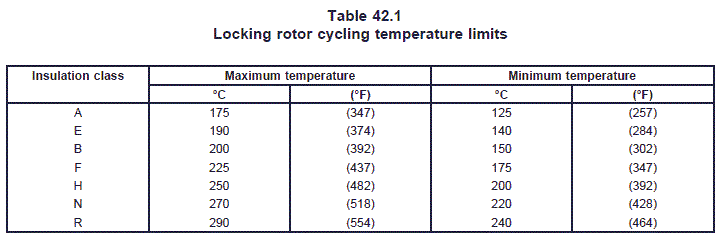
temperatures shall reach the maximum temperature and the minimum temperature shown in Table 42.1,
as determined with a thermocouple. The test duration is to be for 18 days with the motor at room
temperature at the beginning of the test. The motor enclosure is to be connected to ground through a
3-ampere non-time delay cartridge fuse with a voltage rating based on the rating of the motor. Protective
devices are to be bypassed. When the motor does not function throughout the test, a different motor is to
be chosen, and the test started from the beginning. When a part, such as a capacitor, can be replaced in
order for the motor to function, then the test may continue.
42.2.3 As a result of either test:結果符合下列:
a) There shall be no softening, warping, cracking, or other deformation of the part which results
in a reduction of required spacings; 不得造成間隙小於規定
b) The fuse in the grounding conductor circuit shall not open due to a failure of the part under
test; and3A保險司不可斷路
c) The Dielectric Voltage-Withstand Test, Section 37, shall be conducted upon motor burnout
and while still in a heated condition. The motor shall not exhibit a failure of the Dielectric
Voltage-Withstand Test due to a failure of the part under test.耐壓測試合格
42.6 Motors provided with thermal motor protection in the form of an manually reset thermal
motor protector, single-operation device, or a self-holding thermal motor protector
42.6.1 The motor is to remain energized until the protector trips and then the protector is to be reset. This
sequence is to be repeated 59 times.
42.6.2 As a result of this test:
a) There shall be no softening, warping, cracking, or other deformation of the part which results
in a reduction of required spacings;
b) The fuse in the grounding conductor circuit shall not open due to a failure of the part under
test; and
c) The Dielectric Voltage-Withstand Test, Section 37, shall be conducted as soon as the
thermal cutout operates for the 60th time and while still in a heated condition. The motor shall
not exhibit a failure of the Dielectric Voltage-Withstand Test due to a failure of the part under
test.
42.6.3 Motors provided with thermal motor protection provided by electronic circuitry shall be tested under
those conditions consistent with the operation that the circuitry most closely emulates, in accordance with
the following:
a) Protection circuits that emulate a thermal cutoff shall be evaluated by the method specified
in 42.3;
b) Protection circuits that emulate an automatic reset protector shall be evaluated by the
method specified in 42.5; and
c) Protection circuits that emulate a manual reset protector shall be evaluated by the method
specified in 42.6.