UL1004-1 Rotating Electrical Machines –General Requirements
First Edition – September, 2008
Second Edition -
September 19, 2012
MANUFACTURING AND PRODUCTION TESTS
43 Production-Line Dielectric Voltage-Withstand Test
43.1 As a routine production-line test, each unit shall withstand without electrical breakdown the
application of an alternating-current potential at a frequency within the range of 40 – 70 hertz or a
direct-current potential:
a) Between the primary wiring, including connected components, and accessible dead metal
parts that are capable of becoming energized; and
b) Between primary wiring and accessible low-voltage – 42.4 volts peak ac, 60 volts dc or less
– metal parts, including terminals and connector contacts.
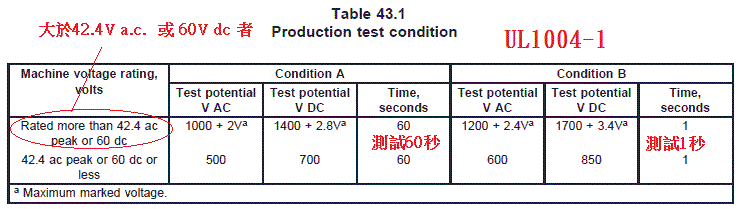
43.2 The test duration and potential shall be as described in either condition A or B of Table 43.1.
43.3 The test potential is to be gradually increased to the required value and the full value is to be applied
for 1 second or 60 seconds, as required.
43.4 The unit shall be at intended operating temperature, at room temperature, or at any intermediate
temperature for the test.
43.5 The test shall be conducted when the unit is fully assembled. It is not intended that the machine be
unwired, modified, or disassembled for the test.
Exception No. 1: Parts such as snap covers or friction-fit knobs that interfere with performance of the test
are not required to be in place.
Exception No. 2: The test is to be performed before final assembly when the test represents that for the
completed unit. Any component not included shall not affect the results with respect to determination of
possible electric shock from miswiring, defective components, unacceptable spacings, or similar
instances.
Exception No. 3: Solid state components that are capable of being damaged by a secondary effect
(induced voltage surge, excessive heating, or similar effect) of the test shall be short-circuited by means
of a temporary electrical jumper, or the test shall be conducted without the component electrically
connected, providing the wiring and terminal spacings are maintained. Additionally, transient voltage
suppression devices other than capacitors connected from primary wiring to dead metal are to be
disconnected during the test when applicable.
43.6 The test equipment shall have a means of indicating the test potential, an audible or visual indicator
of electrical breakdown and, for automated or station type operations, either a manual-reset device to
restore the equipment after electrical breakdown or an automatic-reject feature for any unit that does not
comply. When an alternating-current test potential is applied, the test equipment shall include a
transformer having a sinusoidal output.
43.7 When the rated output of the test equipment is less than 500 volt-amperes, the equipment shall
include a voltmeter in the output circuit to indicate directly the applied test potential.
43.8 When the rated output of the test equipment is 500 volt-amperes or more, the test potential shall be
indicated:
a) By a voltmeter in the primary circuit or in a tertiary-winding circuit;
b) By a selector switch marked to indicate the test potential; or
c) By a marking in a readily visible location to indicate the test potential in the case of
equipment having a single test-potential output.
43.9 When an indicating voltmeter is not used, the test equipment shall include a visual means (such as
an indicator lamp) to indicate that the test voltage is present at the test-equipment output.
43.10 Test equipment other than that described in 43.6 – 43.8 is not prohibited when found to accomplish
the intended factory control.
43.11 For the test, either a specified number of control devices are to be closed or separate applications
of the test potential are to be made so that all parts of the primary circuit are tested.